

What “end-to-end encrypted” actually means here
Every app says it. Here is the specific thing Afarchat does, the part you can check yourself, and the part we cannot do for you.
The claim, and the hole in it
End-to-end encryption means the server carries your message without being able to read it. That part is easy to build and easy to say. The hard part is the question underneath it: how do you know the key your message was sealed to belongs to the person you think you are talking to?
Every encrypted messenger gets that key from a directory, and the directory is run by the company. A company that can hand you the wrong key can read everything, and no amount of encryption below that layer helps. So the honest version of the claim is not "we cannot read your messages" — it is "we cannot read your messages, and here is how you check that we are not cheating".
The safety number
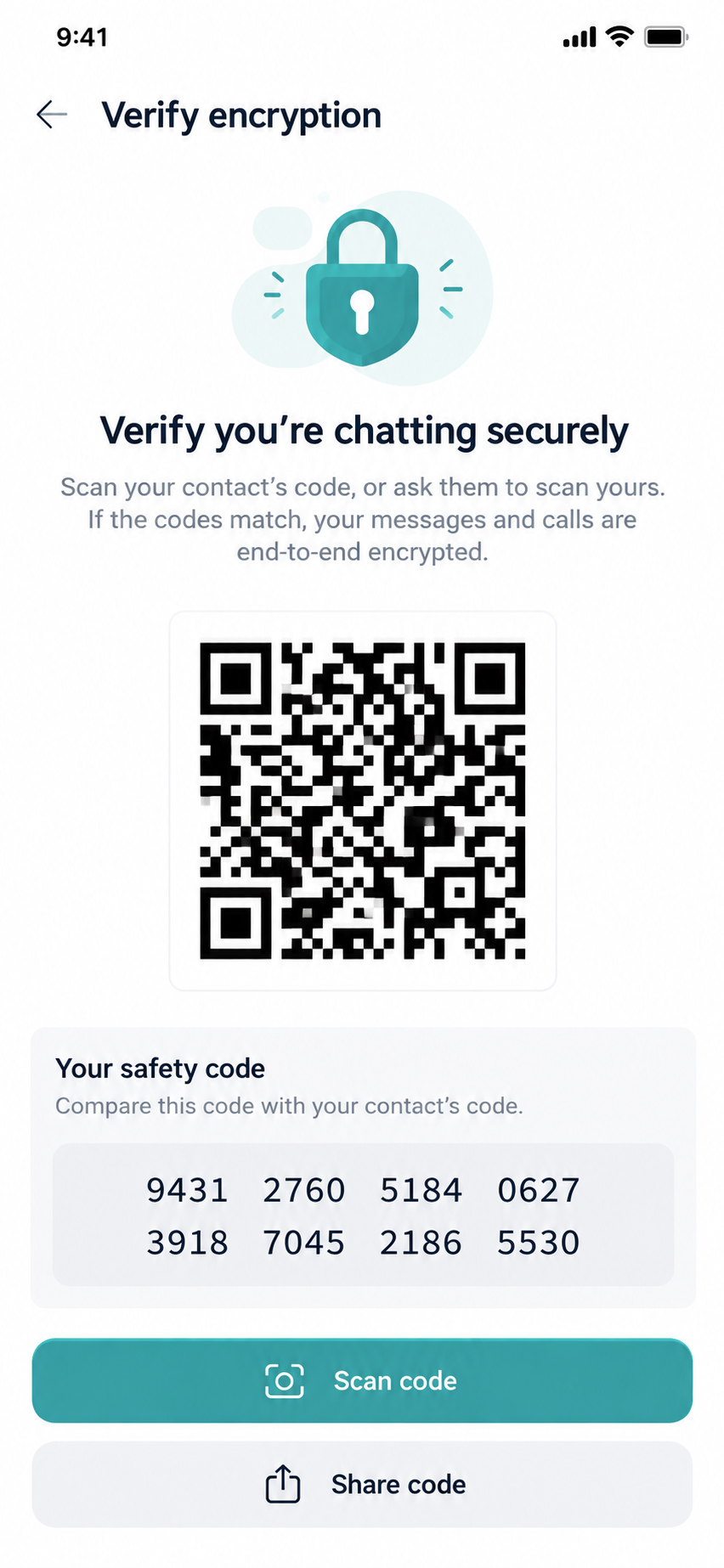
Open any conversation, tap the encryption row, and you get sixty digits derived from both people's keys. Read them to each other over anything we do not control — in person, on a phone call, on a postcard. If they match, nobody is in the middle. If a key had been substituted, the numbers could not match.
The limitation is obvious once you say it out loud: it needs the other person, and it needs a few minutes. Most people will never do it. That is why it is not the only thing we do.
The public key log
Every identity key ever published on Afarchat goes into an append-only log, the same construction the web's certificate system uses. Two things can be proved about it without trusting us.
First, inclusion: this exact key really is entry number N. Second — and this is the one that matters — consistency: the log you saw last week is a prefix of the log you see today, with nothing rewritten. A server that quietly swaps a key has to fork the log to hide it, and a fork fails that check on every device that remembers where it was.
Your phone does this in the background. So does the web client, as of this month. Neither asks you to do anything, and both will tell you plainly if the answer ever comes back wrong.
What we still cannot do
We cannot protect you from someone holding your unlocked phone. We cannot stop the person you are talking to screenshotting what you send. A per-chat PIN hides a conversation from somebody who picks up your laptop, and we say on that screen exactly what it is not: it is not a second layer of encryption, because the messages are already on the device by then.
Being specific about the edges is not a disclaimer. A lock people over-trust is worse than no lock.
Keep reading

Why we call them Flicks
A short video format is not a new idea. What a name buys you is a promise about what the format is for.
The web client is not a wrapper around the app
Afarchat for web is a separate client against the same services. Here is what that costs and why it is worth it.