
The web client is not a wrapper around the app
Afarchat for web is a separate client against the same services. Here is what that costs and why it is worth it.
Two clients, one set of services
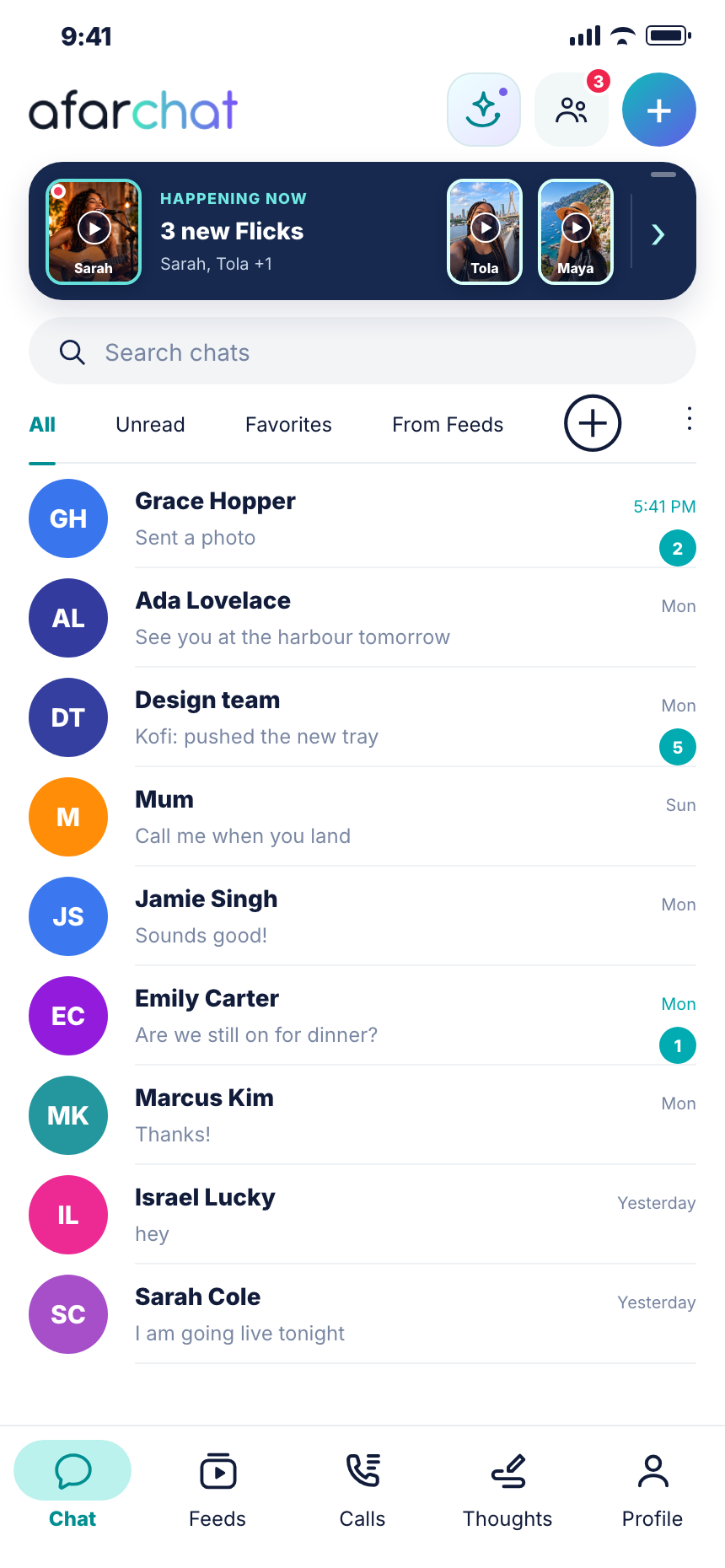
The phone app is Flutter. The web client is React. Neither renders the other: there is no embedded browser on the phone and no phone emulator in your tab. They are two front ends talking to the same gateway, which means every feature exists twice, in two languages, written by people who have to agree.
That is expensive. The cheap option — ship the mobile app inside a web view — produces something that technically runs in a browser and feels, to anybody using a keyboard and a large screen, like a phone glued to a window.
A desktop client should behave like one
On the web you get three panes: conversations, the thread, and details. Keyboard shortcuts for jumping between chats, starting a new one, and searching. A conversation list you can scan forty rows of at once.
None of that has a mobile equivalent, because none of it makes sense on a phone. A product that renders the same on both is not being consistent, it is being lazy on one of them.
The hard part is parity, and parity is not a screenshot
Features drift apart quietly. A control exists on one client and not the other; a button is drawn on both but wired on one. We found fifteen of those in a single sweep — switches a guardian could flip that saved nothing, a Retry that resent nothing, a Follow button that was a span in a button's clothes.
None of it failed a type check, a unit test or a screenshot comparison, because a control that does nothing renders perfectly. What catches them is a harness that drives the real product and asserts what each control actually sent to the server. That suite is now the thing we trust, and the screenshots are what we look at afterwards.
What the browser still will not do
Some things are deliberately absent rather than missing. Searching a conversation happens on your device, not on the server, because the server holds ciphertext and a search it could answer would only find the messages nobody encrypted.
The app-lock PIN is not on the web either: it locks an app, and a browser tab is not one. Saying so is better than drawing a switch that pretends.
Keep reading
What “end-to-end encrypted” actually means here
Every app says it. Here is the specific thing Afarchat does, the part you can check yourself, and the part we cannot do for you.
Why we call them Flicks
A short video format is not a new idea. What a name buys you is a promise about what the format is for.