

Getting paid on Afarchat, end to end
Coins, gifts, paid groups and payouts — where the money goes, what it costs, and why the client never names a price.
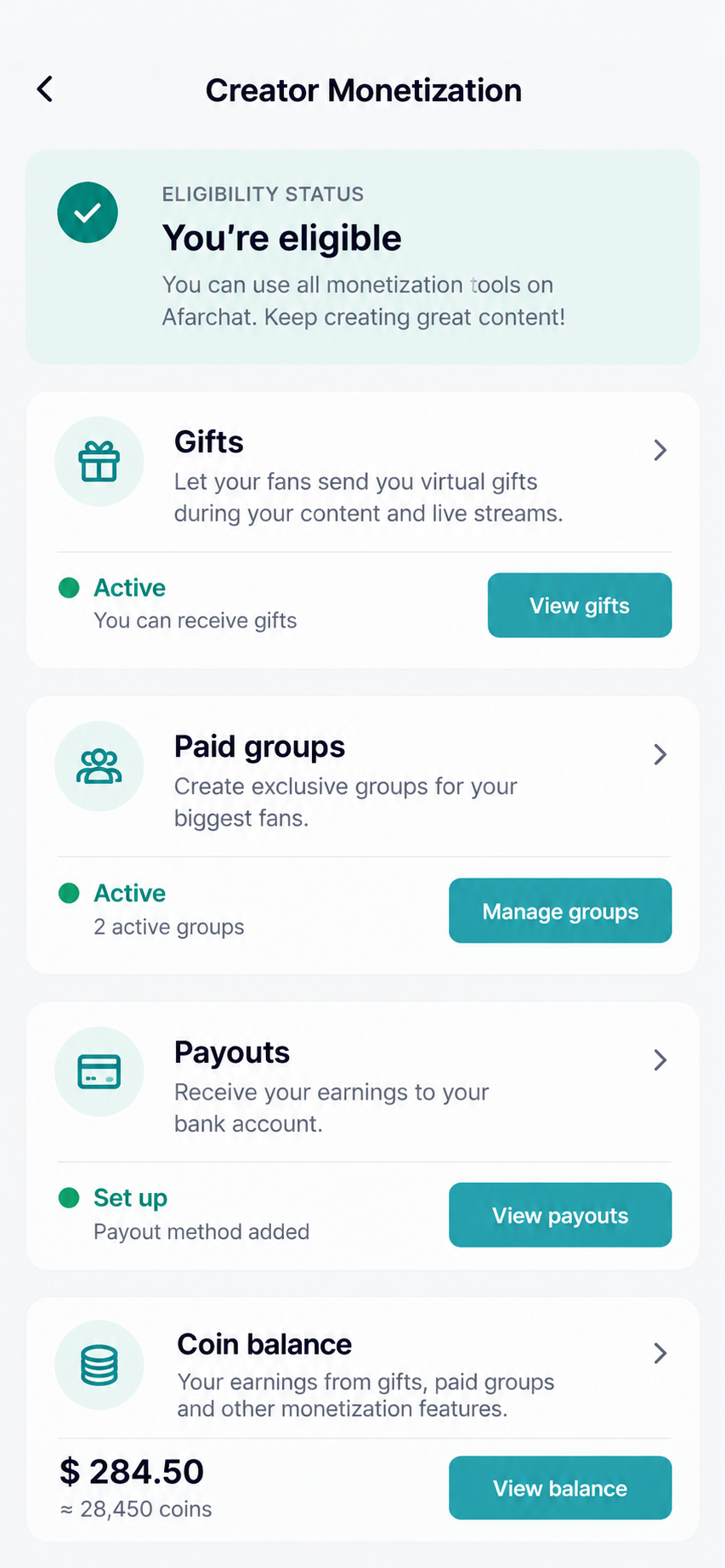
Coins in, gifts across, money out
Somebody buys coins. They send a gift during a live stream or in a chat. The creator's balance goes up, and at some point they ask for a payout and real money lands in a real account.
Each of those is a separate system with its own failure modes, and the interesting engineering is in the seams rather than the steps.
The client never names a price
When you buy a pack of coins, your device sends the id of the pack — never the amount. The price is attached on the server, and the payment provider is told by the server what to charge.
This is not a small detail. A client that posts "charge me ₦500 for 10,000 coins" is a client somebody will edit, and the first person to notice gets free coins until someone checks the ledger.
Payouts have a second pair of eyes
Above a threshold, a payout needs a second approver in the staff console before it moves. Everything either side of that is recorded with who did it and when.
There is a boring reason for the audit log beyond fraud: when a creator asks why something took three days, somebody should be able to answer accurately rather than apologetically.
Keep reading
What “end-to-end encrypted” actually means here
Every app says it. Here is the specific thing Afarchat does, the part you can check yourself, and the part we cannot do for you.

Why we call them Flicks
A short video format is not a new idea. What a name buys you is a promise about what the format is for.